
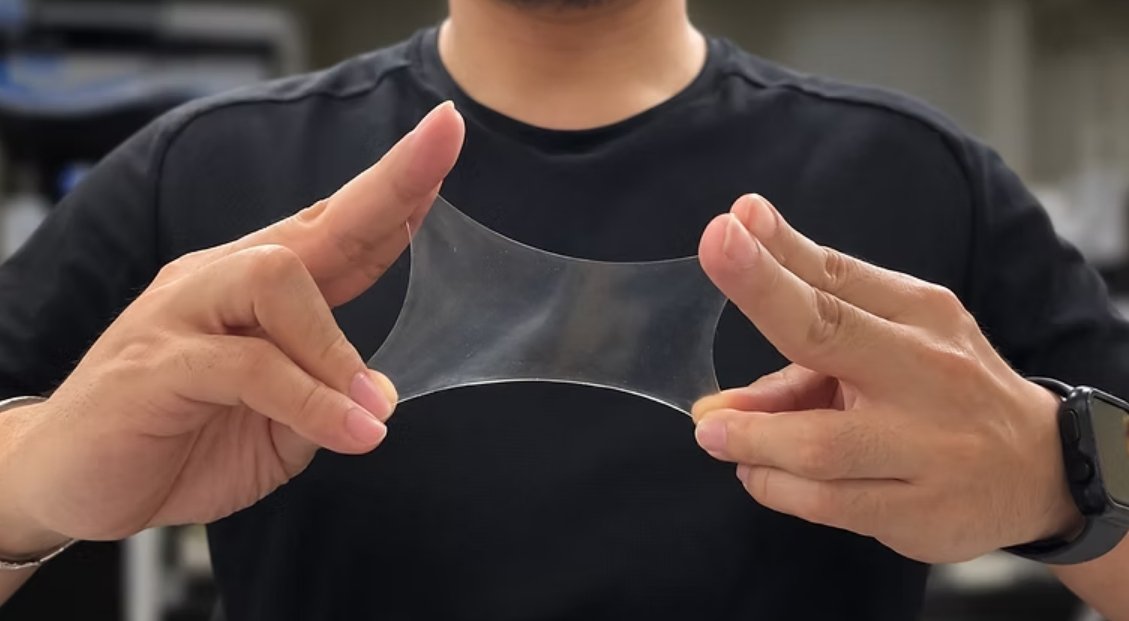
Researchers from the Wearable Imaging for Transforming Elderly Care (WITEC) collaborative research project of the Singapore-MIT Alliance for Research and Technology (SMART), MIT’s research enterprise in Singapore, alongside collaborators from the Massachusetts Institute of Technology (MIT), Nanyang Technological University (NTU Singapore) and the National University of Singapore (NUS), have developed a first-of-its-kind dry elastomer, a rubber-like material, that efficiently transmits ultrasound while remaining soft and mechanically strong, addressing a key materials challenge in developing ultrasound systems for continuous, real-time health monitoring that are wearable and portable.
Unlike many existing wearable health technologies that monitor signals at or near the body's surface, ultrasound can image structures and activity deeper inside the body. However, limited by existing technology, conventional ultrasound systems are not designed to maintain a stable, long-term connection to the body and can typically only be used within a hospital, limiting them to snapshots in time rather than continuous monitoring.
The team has engineered a dry elastomer by interlocking two polymer networks, each built from bottle-brush elastomer (IP-BBE) with densely grafted polyethylene glycol (PEG) side chains. The material is named IP-BBE-PEG and its polymer chemistry and chain connectivity allow ultrasound to pass through efficiently, rather than being absorbed.
Moving forward, the WITEC team will be advancing IP-BBE-PEG toward commercial use by developing scalable and reproducible manufacturing processes, reducing material and fabrication costs, and adapting the material and its processing to the requirements of different products and markets.