In 2026, Novo Nordisk’s Awiqli became the first once-weekly basal insulin to receive approval from the US Food and Drug Administration (FDA) for adults with type 2 diabetes. It was also launched in several other markets, including India, Australia and China. With Eli Lilly’s once-weekly insulin efsitora alfa also receiving US FDA approval in September 2026, once-weekly insulin is emerging as a new segment in diabetes care. Could fewer injections improve adherence, reduce treatment burden and potentially lower the overall cost of diabetes care across Asia-Pacific (APAC)?
The shift towards weekly insulin
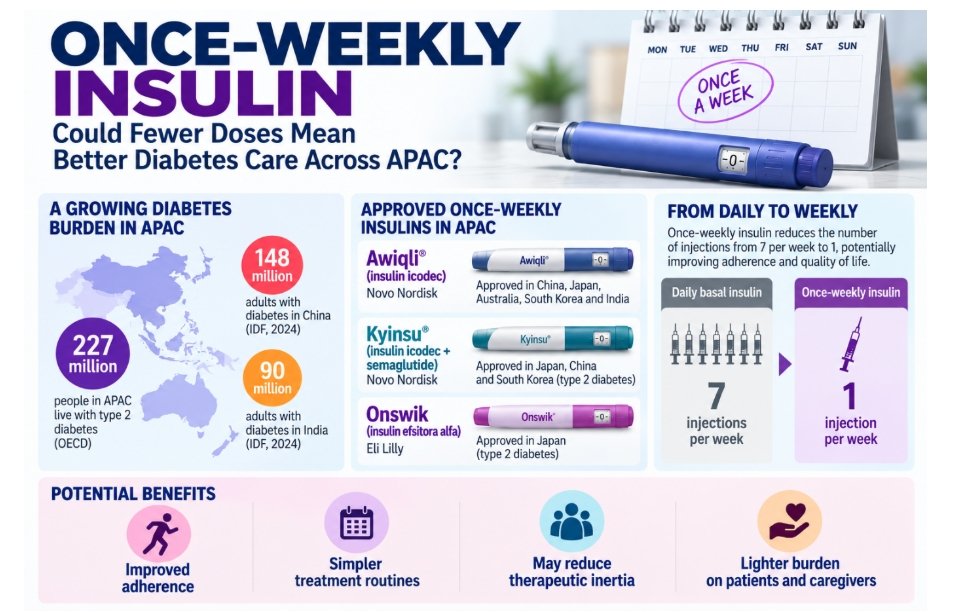
The approved once-weekly insulin landscape is led by Novo Nordisk’s Awiqli (insulin icodec), which has received approval across key APAC markets, including China, Japan, Australia, South Korea and India, for type 2 diabetes and type 1 diabetes. China was the first APAC country to approve Awiqli, in June 2024. Novo Nordisk’s Kyinsu, a once-weekly fixed-ratio combination of insulin icodec and semaglutide, was first approved in Japan in February 2026. It has since also received approval in China and South Korea for type 2 diabetes. In September 2026, Eli Lilly’s once-weekly insulin, Onswik (insulin efsitora alfa), received approval in Japan for type 2 diabetes. However, Eli Lilly has yet to launch it in the Japanese market.
Why Weekly Insulin?
Asia-Pacific carries a substantial share of the global diabetes burden. According to the Organisation for Economic Co-operation and Development (OECD), around 227 million people in the region live with type 2 diabetes, with about half undiagnosed. China and India are among the countries with the largest diabetes populations globally. The latest International Diabetes Federation (IDF) estimates put the number of adults with diabetes at around 148 million in China and 90 million in India in 2024.
Once-weekly basal insulin reduces the injection burden from daily administration to once a week, potentially addressing one of the barriers to insulin persistence: the inconvenience and fatigue associated with frequent injections. Awiqli is designed as an alternative to daily basal insulin and is administered on the same day each week, simplifying treatment routines for adults with diabetes.
“This is particularly significant in APAC, where several major markets face high disease burdens. China alone has approximately 148 million adults living with diabetes according to the International Diabetes Federation—roughly one-quarter of the global adult diabetes population. In high-volume markets, even modest adherence gains can translate into substantial improvements in glycemic management for patients on insulins. Daily injections remain challenging for many patients, and evidence indicates that reducing injection frequency improves adherence among insulin users,” said Prashant Khadayate, Director – Lifesciences Consulting & Research, GlobalData.
“Across APAC, many people living with diabetes face challenges adhering to insulin treatment. By reducing injections from daily to weekly, once-weekly insulin has the potential to simplify diabetes management, improve treatment satisfaction and support better adherence. Beyond convenience, it may help address therapeutic inertia, ease the burden on patients, healthcare professionals and caregivers, and support better long-term disease management. While the impact on healthcare costs will vary by market, improving adherence and persistence is an important step towards achieving better health outcomes for people living with diabetes,” said a Novo spokesperson.
For many people with type 2 diabetes, initiating insulin therapy can itself be challenging because of concerns about injections, inconvenience and treatment burden. Insulin icodec is the first once-weekly basal insulin to reach the market, with other formulations also advancing. It has received regulatory approval for use in type 1 and type 2 diabetes in several countries, including markets across APAC.
“The potential benefits of these new insulin formulations include convenience, reduced inertia and resistance to insulin commencement, and improved quality of life, particularly in the type 2 diabetes space. Combination with once weekly GLP1 injectables may also improve adherence and reduce complexity of treatment regimes. Regional and remote settings may benefit from these new formulations, particularly in low socio-economic groups and groups with poor health literacy who may need assistance with injections and dose adjustment,” said Associate Professor, Neale Cohen, Baker Heart and Diabetes Institute, Australia.
However, the longer duration of action of once-weekly insulin also raises safety considerations, particularly in situations that can increase the risk of hypoglycaemia.
“There are some concerns regarding the long-acting nature of these insulins and the potential for prolonged hypoglycaemia under some circumstances, such as fasting or reduced oral intake. New guidelines will be needed to deal with these risks, particularly for acute illness and planned surgical procedures,” Cohen.
The Cost Question
At first glance, fewer injections could translate into lower treatment costs. In India, Awiqli is available in a 1 mL pen containing 700 units, priced at Rs 2,611, and a 3 mL pen containing 2,100 units, priced at Rs 7,833. At a weekly dose of 70 units, the 1 mL pen provides 10 weekly doses, while the 3 mL pen provides 30 weekly doses. This works out to approximately Rs 261 per weekly dose, or around Rs 1,044 for four weekly doses in a month.
By comparison, Reuters reported that 70 units of daily basal insulin cost around Rs 345 to Rs 453 per dose. CARE Hospitals estimates that conventional insulin therapy in India can cost around Rs 1,000 to Rs 5,000 or more per month, depending on the type of insulin, brand and dosage. However, differences in dosing schedules, formulations and treatment requirements mean that fewer injections do not automatically translate into lower overall healthcare costs.
“The primary cost-reduction mechanism is indirect: improved adherence and persistence support better glycemic control, which can reduce avoidable complications, treatment escalation, emergency visits, and long-term diabetes-related healthcare utilisation. Weekly basal insulin also eases the demand on clinical resources by simplifying regimen management and reducing the need for ongoing injection-related support,” said Khadayate.
In China, Fangzhou's rollout of Kyinsu on an AI-enabled chronic disease management platform illustrates another potential pathway to cost containment. Combining simplified weekly therapy with digital follow-up, streamlined medication access and hospital-to-home management could support sustained adherence beyond traditional clinical settings. Such models may be particularly relevant to APAC markets, where large patient populations place considerable demands on healthcare infrastructure.
“However, the overall economic impact will depend heavily on pricing, reimbursement, and market-access policies. Affordability and reimbursement remain significant hurdles for advanced combination therapies and newer insulin regimens. While once-weekly insulin has the potential to lower total system costs, net savings will vary across APAC markets based on local payer coverage and out-of-pocket costs,” said Khadayate.
Overall, once-weekly insulin offers a promising approach to simplifying diabetes management. By reducing injection frequency, these formulations could improve treatment satisfaction, support adherence and ease the burden on patients and caregivers. However, their long-term value across APAC will depend on clinical outcomes, safety, affordability and access. The key question is whether fewer injections can translate into more consistent treatment, better glycaemic control and measurable improvements in the overall cost and quality of diabetes care.
Ayesha Siddiqui