

Dr Debadeep Bhattacharyya global marketing manager, Pharma/CRO & Dr StJohn Skilton senior global market manager, Biologics, AB SCIEX
Singapore: Biologics Done Right: Steps to a Large World
The number of biotherapeutics in the pharmaceutical drug pipeline has increased significantly over the last decade. Compared to traditional small molecules, biotherapeutics are highly complex molecules and there is increased focus on analytical technologies that ensure better information about process optimization, and the safety and efficacy of biotherapeutic candidates earlier in the process. Mass spectrometry (MS) is a critically useful and efficient tool for routine and investigational analysis in therapeutic discovery, development, and production. Almost every analytical department now routinely uses MS at some stage in the process of therapeutic development.
Traditionally, MS has been used extensively for analysis of small molecules, from identification and characterization in the early stages of drug discovery and development to quantification in the late stage. MS platforms have tended to be role-specific in the small molecule pharma industry. Today accurate mass systems tend to be used for identification of the structure of the molecule and the metabolites that are formed in blood/plasma/urine,while nominal mass systems (also known as triple quadrupoles) are generally used for quantification of the drug candidate in biological matrix. In the world of biotherapeutics, techniques and types might be incorporated into one broad category labeled "MS" because of the evolving nature of the domain. As the pharmaceutical organizations adapt, there is a strong need for understanding the breadth of offerings that MS can bring to enhance the productivity of their workflows.
Challenges in Biologics: Complexities in every direction
Searching for a blockbuster: Drug discovery technologies have a significant opportunity in discovering drugs for severe diseases such as cancer, cardiovascular diseases, Parkinson's disease, central nervous system disorders, etc. However, the slow growth in the introduction of blockbuster drugs could pose a major threat for the growth of this market.
Major technologies in the drug discovery market include proteomics, genomics, QPCR, DNA and protein microarrays, high-throughput screening, mass spectrometry, laboratory information management systems, microfluidics, gel electrophoresis, chromatography, and protein and nucleic acid isolation.
Keeping costs low: As the global population ages, there is a growing pressure to keep the healthcare costs under control. Senior citizens are more prone to chronic diseases. It is in the nation's best interests to keep its population healthy. In addition to this the pressure is paired with the government's and administration's responsibility to pay for healthcare. This situation will magnify in intensity if nothing is done to improve the status of treatment and prevention of diseases among the aging population.
From complicated biologics to more complicated Antibody Drug Conjugates (ADCs): The world of biologics recently received a new form of therapeutic in the form of ADCs. ADCs combine the best of both worlds, i.e., an ideal combination of small molecule drug with the target specificity of a large protein. The cell killing ability of a cytotoxin is joined with the specificity of a monoclonal antibody to produce the next generation of anticancer therapeutics. Creating a successful ADC requires careful selection of the drug, antibody, and linker. In the quest for more targeted therapies and potentially more clinically efficacious drugs, bio/pharmaceutical companies are increasing their research and product development in biologics.
With the recent approval of Adcetris (brentuximab vedotin co-developed by Seattle Genetics and Millenium Pharmaceuticals) and Kadcyla (Genentech), ADCs have gained immense popularity from the drug discovery and development communities. For scientists, the combination of a small molecule, a linker, and a large monoclonal antibody presents a host of analytical challenges, which has to be addressed in order to identify the efficacy and safety of ADCs.
From innovator to biosimilar manufacturer: Increase in number of out-of-patent biotherapeutics has infused a lot of new options for the drug pipeline for Biosimilar industries. According to Credit Suisse Report on Biosimilars, the global biosimilars market is expected to grow to $10 billion by 2015. Top 25 biosimilar products currently drive 83% of global biosimilar sales and it is expected that the new entries in biosimilars will boost the global biosimilars market to $19.4 billion by 2018 (CNBC News).
The development of Mass Spectrometry has not been seen as an obvious efficiency tool, but it is clear that this technology had a major impact for analysis of biotherapeutics. In the 1970s and 1980s, the use of MS, especially MS-MS was extremely informative about the behavior of ions in the gas phase and their dissociation, although the scope of such invention remained within the academic fraternity. With the increased number of biologics in the drug pipeline, scientists are constantly challenged with developing robust, sensitive, reproducible analytical assays to obtain accurate information about the biotherapeutic they are developing in a short time. The emergence of biologics added significant level of complication to the analytical process of identification and quantification of these biotherapeutics. These analytical challenges encourage the growth of higher end MS systems, from sensitive triple quadrupole MS systems to accurate mass systems offering increased accuracy and resolution. More than efficient MS systems, a comprehensive workflow oriented solution is often desired by most, which would enable every scientist develop robust, reliable assays for every biotherapeutic, regardless of their experience and expertise.
The solution
Separations with CESI 8000: CESI marks a combination of capillary electrophoresis (CE) and electrospray ionization (ESI) technologies to create an integrated workflow solution.
With a single approach that increases efficiency and productivity, the CESI 8000 system provides orthogonal and/or superior results compared to dual-method liquid chromatography / mass spectrometry-based approaches. From a single digest and run of a monoclonal antibody, users of CESI-MS gain the following: (a) Identity and Purity information with 100 percent coverage in a peptide map; (b) Heterogeneity information with ultrasensitive glycopeptide quantitation; and (c) Stability information identifying, deamidation, cyclization and oxidation ‒ all highly important to biopharmaceutical scientists. CESI 8000 adds immense value to the biologics workflow as a unique front end analytical platform. Capillary electrophoresis is extensively used in the world of biologics, especially in QA/QC, glycan analysis, etc. The advantages of CESI 8000 and its ability to seamlessly integrate with TripleTOF systems allows an additional benefit of performing MS studies at the flow rate of capillary electrophoresis. This solution greatly benefits characterization of IgG proteins.
Mass Spectrometry with TripleTOF 6600 System: Accurate mass offers significant advantages throughout the production and development workflows in biologics. From initial characterization steps during which one needs to identify if the cell is making the right monoclonal antibody to ensuring the right clone selection, from scaling up the biologics production process to purification, and ultimately determining the ideal formulation that ensures stability of the biotherapeutic, MS enables accurate decision making at every step. Although LC-MS has been one of the most widespread analytical technologies used in traditional drug discovery and development, there are different challenges that LC-MS faces in biologics production and development.
Intact Mass Analysis: Routine and enhanced intact mass analysis provides information at all stages of development: clone selection, process development, formulation, and post-marketing comparability. In the past, these were done by gel, Western Blot, or other techniques that perhaps provided less detailed information. The characterization of intact proteins is required for recombinant proteins (identifying integrity of construct and any modifications including post-translational modification), native proteins, protein-protein or protein-small molecule interactions, and "top-down" sequencing. Historically, LC-MS platforms faced significant challenges in successfully executing these actions.
BioPharmaView Software: Manual methods are simply unable to keep up with the complexity of processing bulk data for large molecules: enhanced data accuracy, integration and report generation are absolute requirements in biologics. BioPharmaView Software offers a powerful new solution for automating core workflows. Software used in traditional and typical biologics workflows often poses several challenges, such as:Â
Â
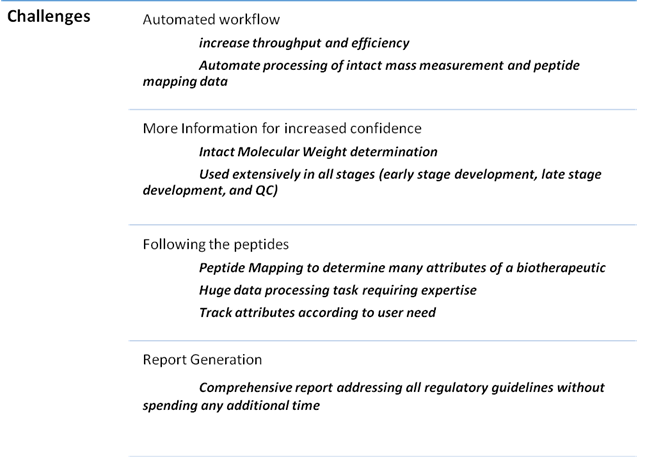
Each of these challenges might be easily resolved with implementation and incorporation of additional software and other resources. However, the cumulative effect of addressing all these challenges can make the entire biologics workflow a tedious, time consuming process, which can be handled only by scientists with exceptional experience and expertise in working with biotherapeutics. Essentially, such requirements negatively impact the profitability of an organization in the business of creating biotherapeutic drugs. BioPharmaView Software addresses these challenges and offers several other benefits, such as better investigation capability, developing better methods and better capability to monitor control of changes.
Conclusion
The inherent complexities of large molecule biotherapeutics often pose unforeseen problems or challenges to the scientists. It is extremely important for both large ethical pharmaceutical organizations and biosimilar manufacturers to develop accurate analytical methods that would allow them to obtain fast, accurate results, and expedite the process of launching the biotherapeutic to market. Meeting the demands of delivering quality analytical data of the biotherapeutics with the experience and expertise of traditional small molecule drug discovery and development can pose significant challenges. The pain of transition from small molecule drugs to biotherapeutics can be significantly minimized not with an analytical system, but a comprehensive solution featuring advanced MS based technologies, innovative software, and orthogonal option of LC and CESI as inlets to the MS. The ability to provide orthogonal information beyond LC-MS based assays is extremely valuable in garnering high value information.