


Mr Eric Rhodes senior vice president, R&D, CTO, Horizon Discovery
Singapore: Over the last 10 years, genome-scale RNA-interference (RNAi) screens have been widely used to investigate the specific role of genes in a given biological context. Large-scale, pooled-format screens employing libraries of shRNAs in viral vectors have identified genes whose silencing led to cell death or reduced proliferation, or conferred resistance to drug treatment or other insult. Initially these screens employed shRNA barcoding coupled with transcriptional arrays for analysis; more recently, next generation sequencing has amplified the power and flexibility of this approach. RNAi screens, however, have two major limitations: incomplete knockdown and off-target effects.
The emergence of CRISPR, an RNA-guided nuclease based gene editing technology, is revolutionizing gene editing in mammalian cells and is being adapted for use in genome-wide screens as an alternative to RNAi screens. Whilst it too suffers from some off-target effects, these effects seem to be less severe than those seen with RNAi. A principal difference however is that CRISPR has the added benefit of achieving a complete knock-out of the target in question, removing any concerns about incomplete knockdown.
In its simplest form, CRISPR gene editing requires only two principal components: a) the bacterial derived Cas9 protein (generally codon optimized for mammalian use) and b) a single guide RNA (sgRNA) comprised of a canonical trRNA sequence fused to a 20 base pair sequence homologous to a genomic target site culminating in the bases NGG (where 'N' is any base). When these two components are delivered into the nucleus of a cell, they form a complex that is guided by the sgRNA and introduces a double-strand break in the genome just upstream of the NGG site. The repair of these breaks tends to create small insertions and deletions that inactivate gene function. The true utility of CRISPR and sgRNA screening has been ably demonstrated in four recent published reports1-4 presenting the results of whole genome screens using lentiviruses to deliver Cas9 and sgRNA libraries into human or murine cells and applying next generation sequencing to quantify the depletion or accumulation of the integrated lentiviral DNA sequences specifying each sgRNA.
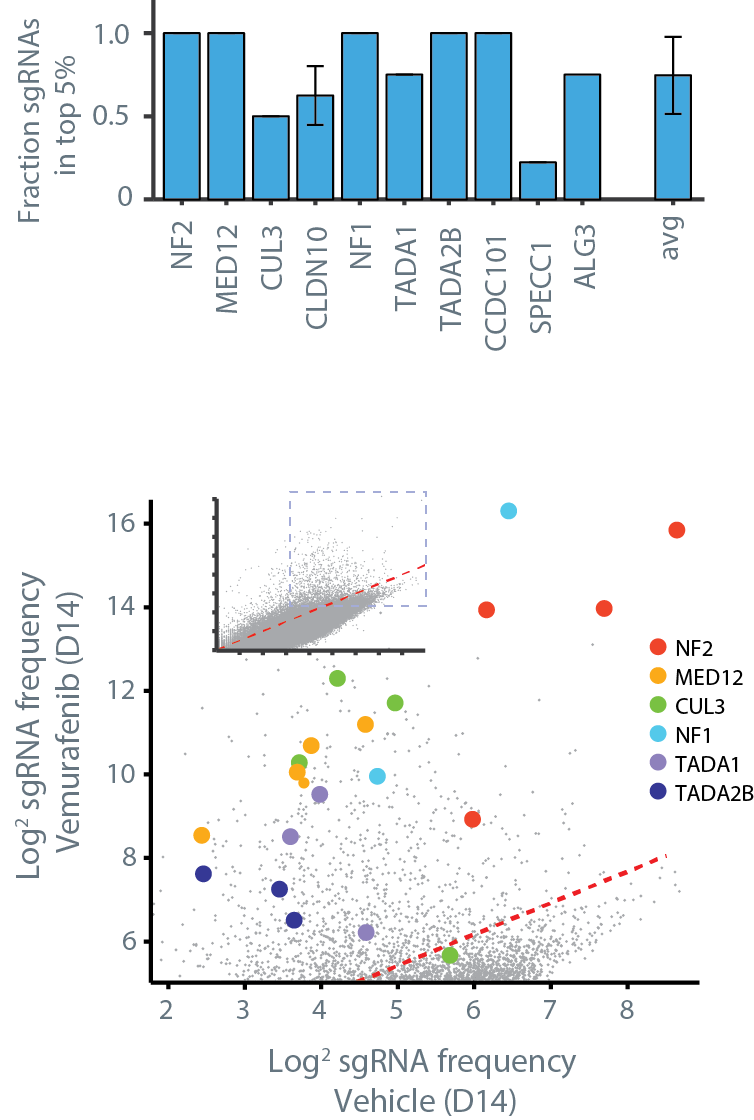
All four papers demonstrate the superlative performance of sgRNA in positive selection screens (where editing of the sgRNA target confers a proliferation advantage). For example, Feng Zhang's group found that the frequency of all the sgRNAs targeting tumour suppressors whose loss is associated with resistance to the BRAF inhibitor vemurafenib were dramatically elevated in a treated population [show data graphic]. Results with shRNAs were far less clear. Similarly, all 6 sgRNAs vs. enhanced green-fluorescent protein tested proved able to eliminate GFP expression in >95 percent of stably transduced cells, whereas shRNAs only reduced expression 7-30 fold.
The platform can also be applied in smaller formats, limiting some of the complex deconvolution required to interpret results of whole genome screens. Libraries of sgRNAs targeting only kinases, for example, can be a cost effective and logical approach to screens aimed at identifying gene targets amenable to drug development using small molecule compounds. Additional libraries focused on specific gene sets characteristic of any particular disease or metabolic pathway can be developed as well.
Design of these libraries, specifically with regard to the choice of specific sgRNAs to include, is still somewhat in its infancy and as we learn more about the behaviour of individual gRNAs and their potential for off-target activity we should be able to design more and more effective libraries and reduce the computational burden inherent in genome wide approaches.
At Horizon we are establishing this technology in house both as a CRO service and to build an internal pipeline of targets for collaborative drug discovery projects with pharma and biotech companies. sgRNA screening is set to become an important tool in oncology for identifying synthetic lethal/co-dependence targets and can also be applied to other therapeutic areas where pathway function can be engineered to regulate survival or expression of fluorescent markers.