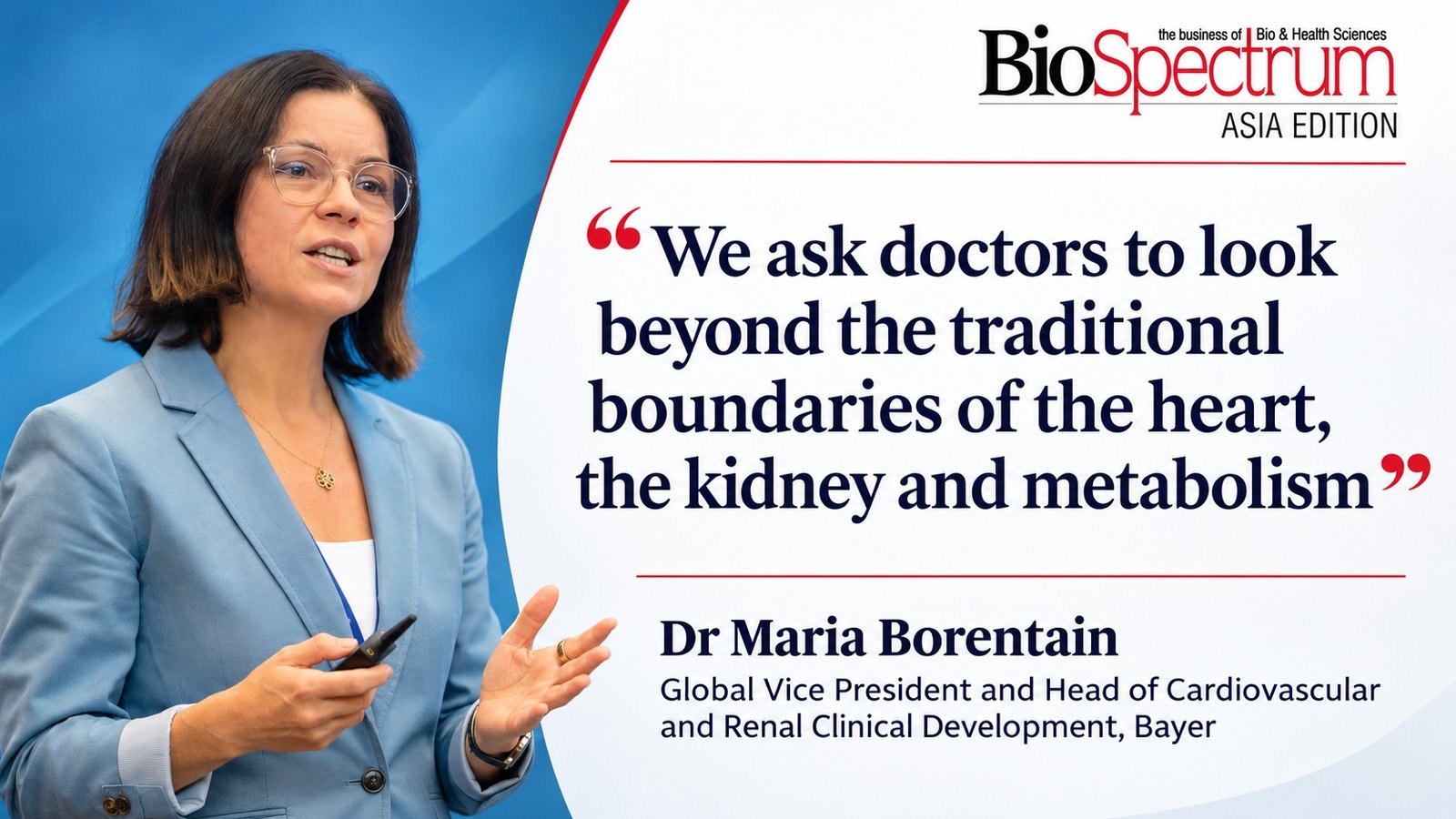
Dr Maria Borentain, a cardiologist who leads Bayer’s late-stage clinical development across cardiovascular, renal and thrombosis therapeutic areas, spoke to BioSpectrum Asia about the rise of the cardio-kidney-metabolic approach, why Asia matters so much to Bayer’s trials, what healthy ageing really means for patients, and how a new class of anticoagulants could ease one of medicine’s most persistent fears: bleeding. Edited excerpts:
Could you begin by telling us about your role and what your team is working on?
I am a cardiologist by training, and at Bayer I lead late-stage clinical development for the cardiovascular, renal and thrombosis therapeutic areas. My team and I run the clinical trials that aim to gain approval for medicines in areas such as heart failure, secondary stroke prevention, acute stroke and chronic kidney disease. We also have compounds in development for rare renal indications and rare cardiomyopathies.
Where is cardiovascular science creating new opportunities to intervene earlier and prevent serious health events?
One of the most important recent developments has been the move towards a comprehensive view of chronic cardiovascular, kidney and metabolic diseases, what we now call cardio-kidney-metabolic syndrome. When the heart is failing, for instance, it has a domino effect on other organs. There is a very strong interaction between the heart and the kidney. These two organs work in tandem, in a continuous loop of pressure and volume. So if somebody has heart failure, it has implications for the kidney, and if somebody has kidney disease, they will very likely develop heart failure at some point in their lives.
There are shared risk factors, but this is also a great opportunity for doctors to treat multiple diseases at once and be more effective. In the past, cardiologists treated heart failure and cardiovascular disease, nephrologists treated kidney disease, and endocrinologists or primary care physicians managed diabetes and other endocrine conditions. Today we ask doctors to look holistically. If a patient has one of these diseases, we want physicians to look beyond the traditional boundaries and understand the risks to other organs. A cardiologist should not think only about the heart, but also about what a condition means for the kidneys.
At Bayer, we try to develop medicines that act across multiple organs, protecting the heart and the kidney while also preventing the worsening of diabetes and other metabolic conditions.
How is ageing across Asia changing clinical development priorities for cardiovascular and renal diseases?
That is an important point. Around 26 per cent of all participants recruited into our clinical trials come from Asia, which is higher than for many other companies. If you look at global recruitment across the industry, the share from Asia Pacific is typically much lower. Ours is higher because we have a real footprint in the region. We are present across Asia Pacific, we want to work with investigators throughout the region, and we have built good relationships with healthcare systems, hospitals and investigators.
One thing Bayer has that many other companies do not is in-house clinical operations. Our monitoring is carried out by Bayer employees who work directly with investigators and visit them at their sites, whereas many other companies rely on contract research organisations. By keeping clinical development, and clinical operations in particular, in house, we have built extremely strong relationships with our investigators.
How closely should cardiovascular and renal health be considered when developing strategies for healthier ageing and longer independence?
You have put it exactly right: it is about independence. We are talking about functional independence and cognitive independence. To the trio I mentioned earlier, cardio-kidney-metabolic, I am sure that brain health will be added in the future. Brain health is critical for keeping cognitive independence and quality of life, so cardiovascular, kidney, metabolic and brain health need to be considered together, with the goal of preventing subsequent events.
At every stage of life we need to prevent. We need to prevent the first occurrence of an event. But as people get older, many already have the disease, sometimes at an advanced stage. So we also need to do something for people who are already living with the disease: prevent it from deteriorating and help them maintain their lifestyle, their independence and their ability to carry out daily activities.
Looking towards 2027, which scientific or clinical advances could have the greatest impact on cardiovascular and renal care?
Our Factor XIa inhibitor for secondary stroke prevention is designed to prevent recurrent strokes without increasing the risk of bleeding. That is a huge innovation, because until now treatments in this area have reduced the risk of thrombosis but, at the same time, increased the risk of bleeding.
Bleeding is something that physicians and patients are very afraid of. Nobody wants it. Surveys have shown that many patients would rather have a second stroke than suffer a bleed, because it is so feared. Physicians do not like medicines that cause bleeding either, because they feel it is their fault if a patient bleeds. As a result, current treatments are underused. I believe a Factor XIa inhibitor will help ease this fear of bleeding, so that many more patients are treated to prevent secondary strokes, which tend to be more severe, more debilitating and more often fatal.
Finally, is there anything important we have not touched upon that you think our audience should know?
I would highlight innovation and, in particular, education. Today we have the opportunity to use artificial intelligence to educate people, because we do not have enough doctors, enough nurses or enough healthcare providers to care for everybody. Trust and the right kind of information are essential, and social media is full of misinformation. So we need to make sure we educate people in the right way.
AI can also help connect people more closely to care. Telehealth is already widely used. We need to harness artificial intelligence to bring patients and their families closer to healthcare providers and to trusted sources of information, so that education leads to better health.
Editor’s note: On 9 November 2026, the US FDA approved Bayer’s asundexian (Sunharbo), the first approved oral Factor XIa inhibitor, for secondary stroke prevention in adults after a non-cardioembolic ischaemic stroke or transient ischaemic attack, used alongside antiplatelet therapy. In the Phase III OCEANIC-STROKE trial of more than 12,000 patients, it reduced the risk of ischaemic stroke by 26 per cent versus placebo, with similar rates of major bleeding.