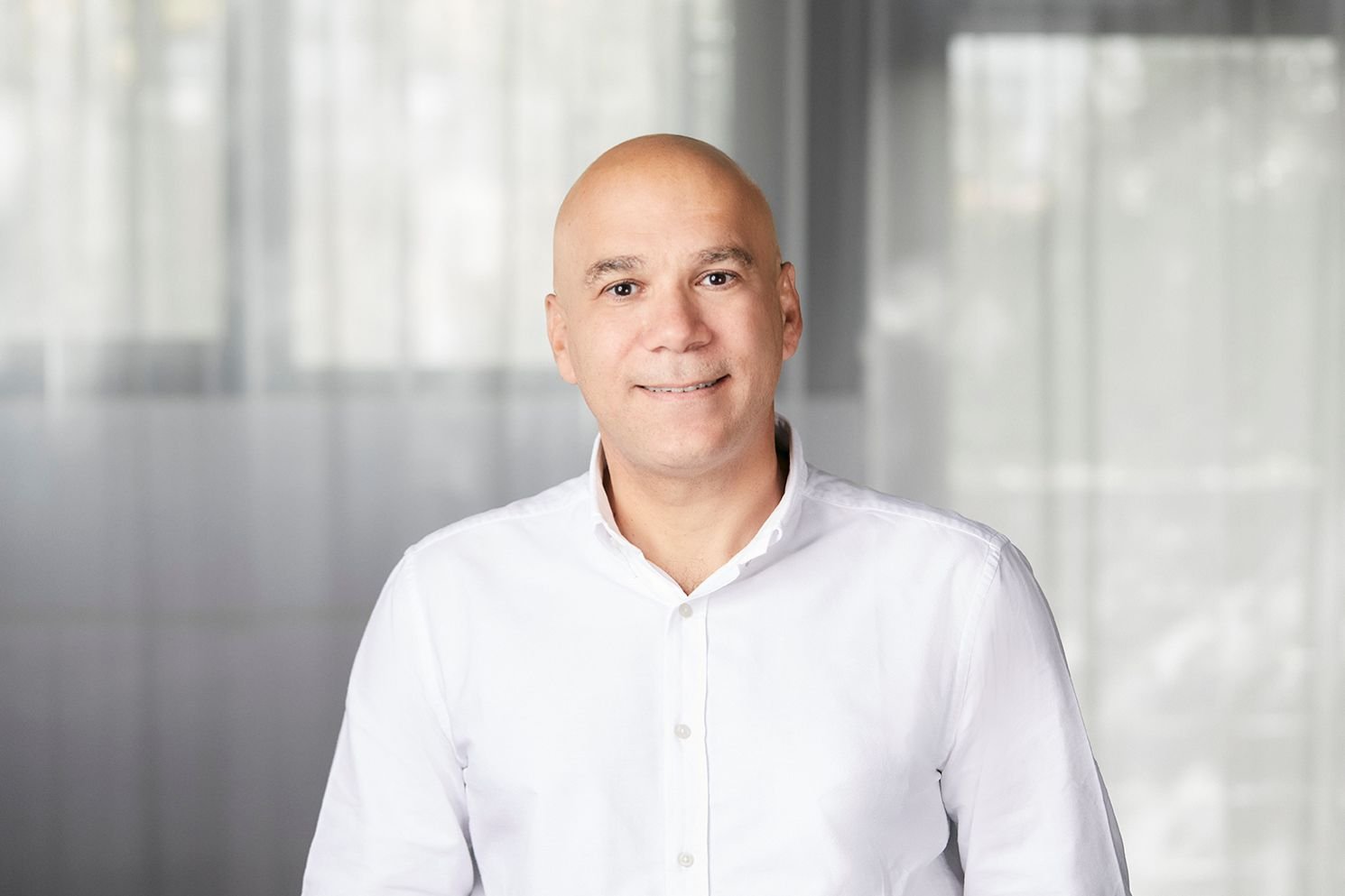

What will it take to turn fundamental scientific discoveries into the next generation of healthcare innovations? At AI4Sci, Nobel laureates Dr Fred Ramsdell and Professor Sir Konstantin Novoselov offered perspectives from two different disciplines: immunology and materials science.
Ramsdell, a recipient of the 2025 Nobel Prize in Physiology or Medicine for discoveries concerning peripheral immune tolerance, sees opportunities to better understand immune regulation and ultimately restore normal immune function in patients with autoimmune disease.
Novoselov, a recipient of the 2010 Nobel Prize in Physics for groundbreaking experiments involving graphene and a professor at the National University of Singapore, is exploring intelligent materials that can sense and respond to their surroundings, potentially enabling medical technologies that interact more closely with living systems.
In separate interviews conducted at AI4Sci and brought together here, the two Nobel laureates discuss emerging scientific opportunities, AI’s role in discovery, the challenges of clinical and commercial translation, and Asia’s potential to contribute to healthcare innovation.
Fred Ramsdell: understanding and resetting the immune system
Which unanswered questions in immunology could have the greatest impact on future therapies?
One area I think is understudied is the interface between the neurological and immunological systems. These are almost certainly the two most complicated systems in the human body. Their intersection is apparent, and people study it, but we still know relatively little about how they regulate one another, even though we know that they do.
Understanding how that happens is an area of tremendous opportunity.
There is also enormous potential to use human genetics to integrate different aspects of the immune system. We all have roughly 20,000 genes, but we carry different collections of variants, or alleles. Variation in immune-system genes helps determine how we respond to different challenges.
We have sequenced many human genomes and are building a good collection of these variants. What we have not yet been able to do adequately is connect the combinations of variants that differ between people with biology or disease.
AI could be particularly useful because integrating large datasets will be critical. We are not there today, but I think there is considerable opportunity over the next decade.
What does it take to move a fundamental biological discovery into something that can meaningfully change patient care?
Some of it is timing and luck. When we made the discovery recognised by the Nobel Prize, we understood that it would fundamentally change how we thought about the immune system. What we did not have was a way to use that knowledge therapeutically.
Around the year 2000, the gene and cell therapy approaches needed to apply that discovery to autoimmunity were not available. Advances developed by colleagues in oncology have helped bring those technologies forward, allowing us to consider those possibilities now.
The other requirement is funding with a long-term perspective. When you are developing a new paradigm, rather than making an incremental change to something already well understood, it is difficult to predict how long it will take or where the bottlenecks will appear. It almost always takes longer than expected.
Having an individual or organisation willing to invest both time and money in that process is critical. Funding coupled with the patience to see the work through remains one of the biggest challenges.
Where do you see the most promising opportunities emerging in immune-based therapies?
In the near term, over roughly five to ten years, I think autoimmune disease and cancer remain the most promising areas.
We are thinking about both more holistically than before. Many treatments remain highly targeted, but oncology has increasingly embraced combinations. Sometimes the combination is built into a single medicine; sometimes it involves two drugs. A single intervention that works on its own will occasionally be possible, but I think that will be the exception rather than the rule.
Autoimmunity is somewhat behind in developing those approaches, but I think it is moving in the same direction. Combinations could allow us to manipulate the biology more comprehensively.
Looking further ahead, particularly in autoimmunity, the ambition is to re-establish normal immunity rather than simply treat disease. We want to move towards being able to “reset” an immune system that recognises a patient’s joints, brain, gastrointestinal system or other tissues as targets.
The goal would be for that immune system to stop recognising those tissues in that way, allowing patients to function without that autoimmune response.
How can Asia strengthen its contribution to discovery, and what capabilities should young researchers develop?
Asia has significant advantages, including large populations and, in some countries, centralised health records and healthcare systems. These can bring together genomic, laboratory and clinical information alongside data on health, disease and ageing.
Privacy and other concerns need to be addressed, but in principle these resources can support discovery. That opportunity applies to Singapore as well as other countries in the region.
I also think there is an opportunity to put more emphasis on discovery science: funding unusual ideas and exploring biology that is not already well validated. There are exceptions, and this is not a question of capability or technology. It is about where the emphasis has been placed.
Developing medicines against well-understood targets is valuable, but it is different from discovering new pathways or new aspects of disease biology.
For young researchers, connectivity and teamwork will be particularly important. I entered biotechnology early because I could work alongside excellent molecular biologists, biochemists and computational scientists without having to become an expert in every discipline myself.
When teams are aligned around a question, they can make enormous progress. Being able to draw on other people’s expertise, datasets and perspectives will create considerable opportunities as the volume of scientific information continues to grow.
Sir Konstantin Novoselov: bringing materials closer to living systems
Where do advanced materials have the greatest potential to reshape healthcare and medical technology?
Everything we build depends on materials. Whether it is an artificial heart or a stent, materials are fundamental to its function.
We are working on functional intelligent materials that can be programmed and can actively interact with their environment, changing their properties or even their functions. In that sense, we can bring their behaviour closer to that of real human organs, with the longer-term possibility of creating artificial organs.
We also work on functional membranes and electronics based on ions rather than electrons. Ionic conduction is closer to what happens in the human body, which could make implants more biologically compatible and easier to integrate.
The aim is to reduce the gap between computing systems and biology. It is difficult to predict precisely where the major breakthroughs will come, but artificial organs and brain implants are areas where I expect considerable activity in the coming years.
How could new materials change biosensors, implants and other medical technologies?
We are dramatically expanding the range of materials available, allowing us to tune their properties for particular applications, whether that is a sensor or an artificial organ.
We also want those materials to be multifunctional. A material could act as both a sensor and an actuator.
As a hypothetical example, a stent might sense the presence of nitric oxide and then expand or contract slightly according to what is required. I am thinking aloud here, but it illustrates the possibility of materials that do more than provide passive structural support.
Two-dimensional materials are already being explored for biological and healthcare applications, including drug delivery, biosensing and cancer treatment. Their structures offer considerable scope for multifunctionality.
By combining them into complex heterostructures, we can explore materials that bring sensing, actuation and therapeutic functions together. There are many opportunities, but we are still learning how to work with them.
What scientific and technological challenges must be addressed before these materials can be incorporated more widely into medical devices?
We currently know how to work efficiently with a relatively small number of materials. Electronics relies heavily on silicon, while general engineering makes extensive use of steel, aluminium and titanium. That limits the functions we can obtain from the structures we build.
We need to explore new materials and develop artificial or composite materials that combine useful properties from different structures.
We are only beginning to understand how to construct these functional materials, manufacture them efficiently and integrate them into existing electronic, mechanical and biological systems.
There is also a more fundamental challenge. We do not yet have all the right tools to describe materials that actively interact with their environment.
We have traditionally treated materials as passive components. That approach is changing, but we still need to learn how to work with this new class of active materials. Moving towards commercial applications requires progress in that understanding as well as in production and integration.
How do you see AI, advanced materials and Asia’s research capabilities shaping the next generation of medical technologies?
There are two developments taking place simultaneously.
First, we are using AI to design new materials and structures. We are still at an early stage, but I believe significant results are close and that we will see more of AI’s potential in materials design.
At the same time, new materials are enabling new computing systems. Integrating sensors and computing with biological structures requires different approaches, and materials innovation can help make those approaches possible.
These two processes—using AI to develop materials and using materials to develop new computing architectures—could change how we create medical devices.
Asia already has strong capabilities in electronics manufacturing and materials science, and advanced materials research is increasingly based in the region. I expect to see new companies emerging from local universities and research groups as these capabilities develop.