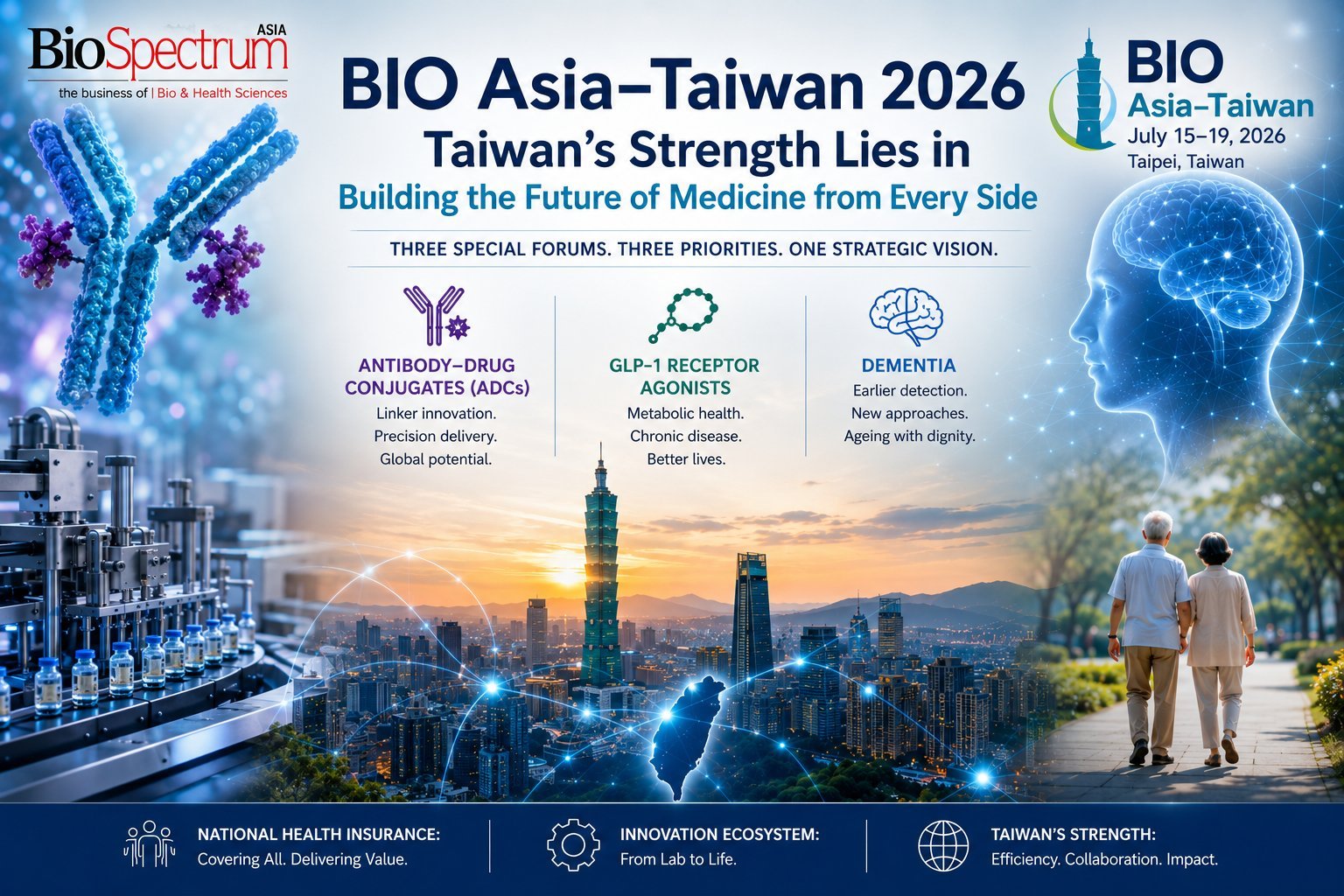
Antibody-drug conjugates, GLP-1, dementia. Three Special Forums at BIO Asia-Taiwan 2026, three unrelated areas of medicine, and one piece of strategic clarity running underneath all of them.
Three running orders. Three different diseases.
It is the kind of detail a reader’s eye slides over, and it is the most informative thing on the page. Because two rooms away, in the main Innovation Forum programme, the week’s other set-piece session on extracellular vesicles was opened by a different department entirely: the Ministry of Economic Affairs, whose business is what Taiwan can build and sell to other people.
The Special Forums were opened by the ministry that will one day use what these companies build.
And they were opened by it three times. Then, in each of the three, the keynote and the closing remarks were delivered by the same person, Ms Shih-Chia Lin, executive director of the Foundation of Medical Professionals Alliance in Taiwan. Six appearances, three subjects, one health policy voice bracketing every conversation from the front and the back.
That is not a scheduling artefact. It is authorship. Somebody decided that antibody-drug conjugates, GLP-1 receptor agonists and dementia belonged in a track of their own, and the thing that binds those three is not science. It is foresight. They are, between them, the three technologies most likely to reshape the health of every ageing society on earth over the next two decades, and Taiwan has chosen to think about all three now, while there is still time to plan.
THE ADVANTAGE NOBODY NAMED
Taiwan’s National Health Insurance covers effectively the whole population at a share of GDP most developed systems regard as impossible, achieved through a global budget and real discipline on pricing. That efficiency is a genuine national achievement, and it has an underappreciated second effect: it raises Taiwanese innovators in a system that rewards value from the first day, which is exactly the test every health system in the world is now applying.
Hold that in mind while reading the three running orders, because it turns a set of technical sessions into something considerably more interesting: a country working out, technology by technology, exactly where it can lead, where it can supply, and what it needs to build next.
FORUM ONE What Taiwan can make
The most revealing thing about the ADC forum is what never appears in it. Cancer.
Seven presentations, and not one is a clinical oncology talk. No tumour type. No trial readout. No patient population. Instead the running order moves through a market survey, a linker, radiochemistry, HIV, bioanalysis, a conjugation platform, and finally manufacturing equipment. Antibody-drug conjugates are the most commercially aggressive category in oncology right now, and Taiwan convened a forum about them that declines to discuss treating anybody.
That is not an oversight. It is a position. The forum treats ADCs not as a class of cancer medicine but as a chemistry and manufacturing discipline that happens to have found its first market in oncology, and it is a discipline you can sell to whoever does the treating.
The clearest signal is where the time went. The longest slot of the forum, at double the length of any other, belonged to Dr Young-Sun Lin, president of Tripartite Therapeutics, on a universal linker for potent ADCs.
That allocation is correct, and it repays explanation. An ADC has three parts: an antibody that finds the target, a payload potent enough to kill what it lands on, and a linker holding the two together. The antibody is understood. The payload is decades-old chemistry. The linker is where the medicine lives or dies, because it must survive circulation intact and then let go only at the destination. A linker that leaks poisons the patient and the therapeutic window closes. And the word carrying the commercial weight is universal: a linker that is not bespoke to one antibody and one payload stops being a product and becomes a toll booth.
The forum then does something quietly radical. Dr Jing-Yi Huang, senior director of R&D at TaiMed Biologics, presents a CD4-targeted ADC platform built on TMB-365, aimed not at a tumour but at HIV functional cure.
TaiMed is the company behind ibalizumab, one of the very few Taiwanese-originated biologics to win US approval, and its expertise has always been HIV antibodies rather than oncology. Watching it point ADC architecture at the viral reservoir is the single most interesting item in the forum, and it is also the forum proving its own thesis in public. If conjugation is a platform rather than a cancer strategy, the platform should travel. Here is a domestic company driving it somewhere nobody expected.
Around those two sit the enabling disciplines, and each is a bottleneck wearing a slot. Dr Michael Evans of UCSF, the only foreign academic on the running order, on chemical strategies to widen the therapeutic window in radiopharmaceutical therapy, which marks the forum’s quiet second subject: this is a radioligand session as much as an ADC one. Dr Luke Bi, head of APAC bioanalysis at Labcorp, on bispecific ADCs and the analytics they demand, because an ADC trial requires you to measure total antibody, conjugated antibody, free circulating payload and the distribution of payload per antibody, each with its own validated assay, and programmes stall on assays rather than ambition. Dr Shih-Hsien Chuang of HoneyBear Biosciences, on Taiwan’s first antibody radionuclide conjugate and a site-specific glycan conjugation platform, which is a manufacturing argument dressed as chemistry: conventional conjugation produces a heterogeneous mixture rather than a compound, and putting the payload in a defined place every time is how you make a product a regulator can recognise.
And then the forum ends. On equipment. Ms Kate Seow of Sartorius, on process and facility design for flexible, safe and efficient ADC manufacturing, where the word doing the work is safe: ADC payloads are potent enough that making them is partly an occupational hazard problem, requiring containment that ordinary biologics plants do not have.
THE SHAPE OF IT
Market, linker, radiochemistry, a non-oncology application, assays, conjugation, plant. It is a value chain rather than a scientific programme, and it closes on a factory. On this evidence Taiwan is not chasing the next blockbuster. It is building the capabilities that every blockbuster will need, which is the larger and more durable opportunity.
FORUM TWO What Taiwan will pay
The second forum is the only one of the three whose title names its own anxiety out loud. Not GLP-1 science, not GLP-1 opportunity: the structural impact of GLP-1 on the healthcare industry, with the keynote adding and policy initiatives in case anyone had missed the point.
The framing is more honest than most of what is said about this drug class anywhere. No category in living memory has arrived carrying this combination of clinical breadth, eligible population and unit price. For a health system the question stopped being whether the drugs work some time ago. The question is what happens to a global budget when a large fraction of the adult population acquires a legitimate clinical claim on a chronic injectable.
So the running order splits, cleanly, into two halves that never quite acknowledge each other.
The first half is Taiwan asking whether it can be a supplier, and every answer is about delivery rather than discovery. Mr George Yeh, chief executive of TLC BioSciences, takes the longest slot on long-acting GLP-1 lipid nanoparticle formulations. It is a shrewd place to stand: the molecules are spoken for and their intellectual property is not available, but how long a single dose lasts is a separate discipline with its own patents. If weekly becomes monthly, whoever owns the depot owns something valuable without having discovered anything at all.
Mr Tom Tseng of Formosa Laboratories appears next, and the programme lists his job title where a talk title should be. Read that how you like; the presence is the argument. GLP-1 drugs are peptides, and the chokepoint in the global GLP-1 boom has not been demand, or even fill-finish. It has been peptide API capacity. A Taiwanese API and CDMO house is not in this room to discuss science. It is in the room because the world is short of precisely what it makes. Mr Yu-Kang Chao and Mr Siegfried Gschliesser of Anya Biopharm follow on oral GLP-1, which is the correct strategic target for the same reason: an oral peptide is a bioavailability problem, and a bioavailability problem is one you are allowed to compete on without owning the molecule.
ONE DETAIL WORTH PAUSING ON
Anya’s slot is shared by a managing director and an investor relations officer. An IR officer, presenting at a forum opened by the health ministry. With the Investment Summit running in the same building, somebody has read this room as a capital markets audience, and they may well be right.
Then the second half arrives, and the conversation opens out.
Novo Nordisk is here. The originator, in the room, at a forum convened by the health ministry. And look at who it sent. Not medical affairs. Not R&D. Mr Chang-Min (James) Wang, head of market access, public affairs and communications, the function whose work sits precisely where industry and health system meet.
His subject is semaglutide beyond weight loss, and that phrase carries real clinical weight. As the evidence base extends across cardiovascular and renal outcomes, the class moves from something understood as weight management to something understood as treatment for serious chronic disease. That reclassification matters to every health system on earth, and having the originator make the case directly, in a room convened by the ministry, is how the conversation ought to happen.
An originator and a health ministry, discussing access in the open, before the demand curve arrives rather than after it. That is a mature conversation, and a rare one.
FORUM TWO · WHY THE ROOM MATTERED
And then, last, the brake. Dr Ding-Cheng Chan, superintendent of National Taiwan University Hospital Bei-Hu Branch, is the only clinician on the running order, and he closes the substantive programme on GLP-1 in geriatric medicine.
The choice of speciality is thoughtful, and in Taiwan it is essential. In older patients the question about this class is not only whether weight comes off but what should stay. GLP-1 therapy affects lean mass alongside fat, and in an older patient muscle underwrites independence. Giving the final word to a geriatrician, in one of the world’s fastest-ageing societies, is a forum designing for the patients it will actually treat. It is the kind of clinical judgement that makes adoption work.
FORUM THREE What Taiwan must find
The third forum states its thesis in the keynote title and then spends the rest of the session proving it: from disease care to early screening.
Five substantive talks. Four are about detection. One is about a drug. In the era of the first approved disease-modifying Alzheimer’s antibodies, that ratio looks inverted, until you notice that this is a health system’s logic rather than a pharmaceutical company’s.
The new drugs work early, in patients with confirmed pathology and mild disease. Which means the decisive capability in treating Alzheimer’s is not access to medicine. It is an apparatus capable of finding the right patients early, at population scale, at a price a national programme can sustain. That is not something a pharmaceutical company builds alone. It is a screening programme, and screening programmes are built by health ministries, which is exactly why one convened this. Taiwan is not waiting for the problem to arrive before designing the answer.
Dr Jung-Lung Hsu, president of the Taiwan Dementia Society, takes the longest slot to set the baseline: what Taiwanese clinics can actually do today, and what the arrival of disease-modifying therapy demands that the system cannot yet supply.
Then the detection stack, assembled in ascending order of scale. Dr Ming-Kuei Jang, founder of Aprinoia Therapeutics, on tau PET imaging in early diagnosis and treatment decision-making. Note the second half of that: not diagnosis, decision-making. Amyloid tells you pathology is present; tau tracks closer to where the disease has actually reached. When a physician must decide whether a specific patient should receive an expensive antibody carrying real risk, the imaging is not a curiosity. It is the gate.
Dr Yu-Ming Shiao of Cold Spring Biotech follows on enabling early detection at scale, and those three words are the commercial centre of the entire forum. PET is accurate, expensive, and will never screen a population. Everything that matters here lives in the gap between what a memory clinic can confirm and what a nation could afford to run on millions of people.
Dr Charles S.Y. Yang, chief executive of MagQu, answers exactly that with quantum sensing for blood-based biomarkers, using superconducting magnetic detection to read proteins present in blood at vanishingly low concentrations. A blood test that works at population scale is the only thing that converts early screening from a policy aspiration into a programme, and it is a distinctly Taiwanese piece of engineering to boot.
And then the one therapeutic, arriving with fresh news behind it. Dr Hung-Kai Kevin Chen of Elixiron Immunotherapeutics presents enrupatinib and neuroinflammation as a disease-modifying target, under a slide reading the breakthrough moment.
Five weeks before this forum, Elixiron reported positive interim results from an ongoing Phase 2 proof-of-concept study of enrupatinib, also known as EI-1071, a brain-penetrant CSF-1R inhibitor designed to damp microglia-driven neuroinflammation rather than clear amyloid. The company said the interim analysis showed a favourable safety profile, clear target engagement measured by TSPO-PET imaging, and preliminary signals of benefit in a biomarker-selected subgroup. Chief executive and chief medical officer Chen said at the time that the company is, in his words:
advancing to a larger, placebo-controlled study with clear momentum
HUNG-KAI KEVIN CHEN, ELIXIRON IMMUNOTHERAPEUTICS · INTERIM RESULTS ANNOUNCEMENT, 11 JUNE 2026
WHAT THE INTERIM SHOWS
The study is an open-label proof-of-concept in a small evaluable group, with brain inflammation imaging as the primary pharmacodynamic endpoint. Within a biomarker-defined subgroup, 80% of participants showed TSPO-PET signal reductions above 30%, and the company reported no drug-related serious adverse events and no clinically significant liver toxicity, which it notes may distinguish enrupatinib from earlier compounds in its class. That is precisely the result an early proof-of-concept is designed to produce: evidence that the mechanism engages, a candidate biomarker to select responders, and a clear reason to run the larger placebo-controlled study now planned. Elixiron has been admirably transparent about its own design, and the next study is where the promise gets tested.
It is also, taken with the rest of the forum, a coherent strategy rather than a consolation. Amyloid is spoken for. The antibodies belong to Eisai, Biogen and Lilly, and confirmatory trials in that field cost more than most national research budgets. Neuroinflammation is an open target where a small company with a brain-penetrant oral molecule can genuinely compete. Surround that one shot with four detection technologies and you have an accurate picture of where a mid-sized economy can actually play in Alzheimer’s: build the screening layer everyone will need, and take a swing at a target nobody has locked up.
THE READ Three forums, three different answers
The easy version of this story writes itself: Taiwan wants to be both a supplier of the next generation of medicine and a system capable of adopting it well. True, and admirable, and a little too neat.
The running orders say something more precise, and more impressive. The three forums do not give the same answer. They give three different ones, and each is correctly matched to what Taiwan actually brings.
On ADCs, Taiwan is building to supply the world. The forum contains no oncology because Taiwan is not trying to out-spend anyone on tumour trials. It is going after the chemistry, the conjugation, the analytics and the plant, and selling those to everyone who is. It is the classic Taiwanese move, executed in a new category: find the layer of the value chain that everybody needs and nobody can easily replace.
On GLP-1, Taiwan is playing both hands at once, deliberately. Its companies are moving on the peptide, the depot and the oral formulation for a world that cannot make enough. Its health system is preparing, early, for a class of medicine that will reach a very large number of its citizens. Putting the originator, three domestic suppliers and a geriatrician on one running order is not a contradiction. It is a country looking at the same technology from every side it will encounter it from.
On dementia, Taiwan is building the layer everyone has forgotten to build. The therapeutic race is crowded and expensive. The detection layer that every one of those therapies depends on is wide open, and it happens to reward exactly what this island is good at: sensors, precision engineering, imaging chemistry and scale. Four detection companies and a well-targeted therapeutic on one running order is not a country behind the curve. It is a country that has spotted where the curve is going.
TWO MINISTRIES, ONE WEEK
The Ministry of Economic Affairs convened the question of what Taiwan can build. The Ministry of Health and Welfare convened the question of how Taiwan will use it. Most countries run those two conversations years apart, in different buildings, often in different decades. Taiwan ran them in the same week, in the same venue, and the people who need to hear each other were both in the room.
There is a further advantage underneath all three, and it is one Taiwan rarely claims for itself. The National Health Insurance is among the most cost-efficient systems in the developed world, and it earned that through real discipline about what a technology is worth. Every health system on earth is now moving in that direction. Which means a Taiwanese company learns to argue value from its first conversation at home, in front of the toughest customer it will ever meet, years before it makes that argument in Berlin or Boston. Companies raised in that environment do not find the rest of the world harder. They find it familiar.
That is the strength these three forums were convened around, and to the organisers’ credit they did not oversell it. Nobody stood up and claimed Taiwan could simply have all of it at once. What the three running orders show instead is a country doing the harder and more useful thing: going through the list, technology by technology, deciding where it can lead, where it can supply, and where it should build the road before the traffic arrives.
A country that only makes things is a factory. A country that only buys them is a market. Across three rooms this week, Taiwan quietly declined both descriptions, and produced a credible plan to be something better than either.
The Special Forums ran at BIO Asia-Taiwan 2026, Taipei Nangang Exhibition Center: Next Generation ADCs on 16 July, and The Structural Impact of GLP-1 and Transforming Dementia Prevention and Control Models on 17 July. Enrupatinib clinical detail and the quotation from Dr Chen are from Elixiron Immunotherapeutics’ interim results announcement of 11 June 2026.
ankit.kankar@mmactiv.com